 Add to Chrome
 Add to Firefox
 Add to Edge
Geometry-Aware Networking for Low-Altitude Economy: Movable Antennas in Space-Air-Ground Integrated Systems
Apr 20, 2026
Space--air--ground integrated networks (SAGINs) are emerging as a key foundation for future non-terrestrial networks (NTNs) and low-altitude economy services. However, their performance is increasingly limited not only by communication resources, but by the inability to adapt to rapidly changing spatial geometry. Here, spatial geometry refers to the relative configuration among network nodes, obstacles, and targets, which directly determines propagation conditions, blockage states, interference patterns, and sensing observability.This trend becomes more pronounced as low-altitude operations grow in density and complexity, causing the dominant bottleneck to shift from static resource allocation toward real-time maintenance of favorable spatial geometry across layers.In this article, we argue that movable antenna (MA) technology provides a fundamentally new perspective for SAGIN design. By enabling controlled antenna displacement, MA introduces a spatial degree of freedom that allows the network to directly adapt local spatial geometry at fine granularity, rather than passively reacting to it through beamforming or platform mobility.We present a geometry-aware, layered SAGIN architecture, where Low-Earth-Orbit (LEO) provides macro-scale coverage and coordination, High-Altitude Platform Stations (HAPS) enables regional continuity and backhaul support, and MA is incorporated into the layered design to enable fine-grained geometry adaptation, particularly at unmanned aerial vehicles (UAVs) and terrestrial layers where local channel dynamics are most pronounced. We further discuss how such geometry control enhances robustness, supports multi-functional operation spanning communication, sensing, control, and navigation, and enables more flexible spatial cooperation across layers.

3-D Position Optimization of Solar-Powered Hovering UAV Relay in Optical Wireless Backhaul
Jan 29, 2024A major hurdle in widespread deployment of UAVs (unmanned aerial vehicle) in existing communications infrastructure is the limited UAV onboard energy. Therefore, this study considers solar energy harvesting UAVs for wireless communications. In this context, we consider three dimensional position optimization of a solar-powered UAV relay that connects a distant sensor field to an optical ground station (OGS) for data processing. The integrated sensor-UAV-OGS network utilizes radio frequency band for sensor-to-UAV links and the optical band for the UAV-to-OGS feeder link. Since atmospheric conditions affect both the harvested solar energy as well as the optical wireless signal, this study tackles UAV position optimization problems under various channel conditions such as clouds, atmospheric turbulence and dirt. From this study, we discover that the optimum position of the UAV -- that maximizes the end-to-end channel capacity -- is heavily dependent on the atmospheric channel conditions.
Lidar-Assisted Acquisition of Mobile Airborne FSO Terminals in a GPS-Denied Environment
Apr 06, 2023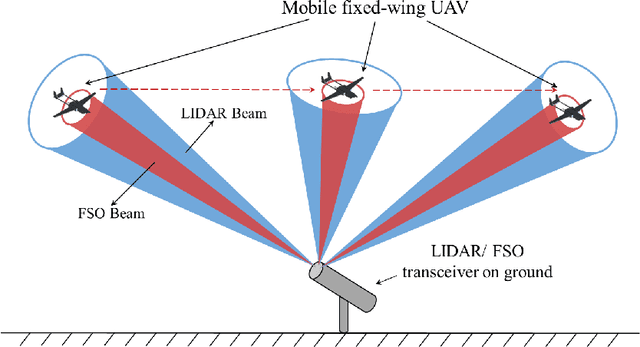
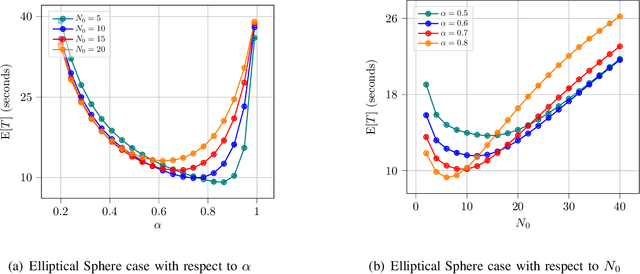
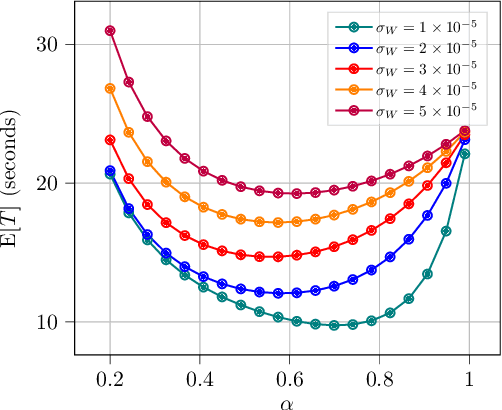
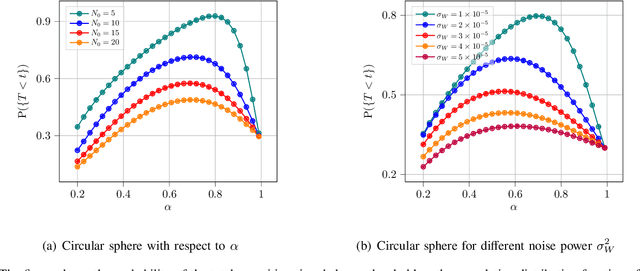
For acquisition of narrow-beam free-space optical (FSO) terminals, a Global Positioning System (GPS) is typically required for coarse localization of the terminal. However, the GPS signal may be shadowed, or may not be present at all, especially in rough or unnameable terrains. In this study, we propose a lidar-assisted acquisition of an unmanned aerial vehicle (UAV) for FSO communications in a poor GPS environment. Such an acquisition system consists of a lidar subsystem and an FSO acquisition subsystem: The lidar subsystem is used for coarse acquisition of the UAV, whereas, the FSO subsystem is utilized for fine acquisition to obtain the UAV's accurate position. This study investigates the optimal allocation of energy between the lidar and FSO subsystems to minimize the acquisition time. Here, we minimize the average acquisition time, and maximize the cumulative distribution function of acquisition time for a fixed threshold. We learn that an optimal value of the energy allocation factor exists that provides the best performance for the proposed acquisition system.